

Diplomacy, Duty, and the Moral Compass of Nations: Rotary Club of Manila Welcomes Former Consul General Atty. Voltaire D. Mauricio at the 29th Weekly Membership Meeting

There are some gatherings in the life of the Rotary Club of Manila that become more than mere weekly assemblies. They evolve into moments of reflection — occasions where history, public service, statesmanship, and moral responsibility converge in one room, among men and women bound by a shared belief that leadership is ultimately an act of stewardship.
The 29th Weekly Membership Meeting of the Rotary Club of Manila, held on May 7, 2026 at the historic Manila Polo Club, unfolded precisely in that spirit. Moderated by Past Director Issam Eldebs, the afternoon gathering carried the familiar warmth and dignity characteristic of Asia's first Rotary club, yet it also possessed a rare intellectual gravitas, owing largely to the presence of the Guest of Honor and Speaker, former Philippine Consul General to Osaka and London, Atty. Voltaire D. Mauricio.

The meeting formally commenced with the Call to Order led by President Raoul C. Creencia, whose steady stewardship throughout Rotary Year 2025-2026 has consistently emphasized fellowship anchored on substance and relevance.
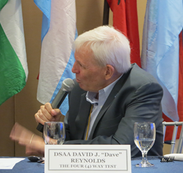
An invocation was delivered by Vice President Ricardo S.B. "Ricky" Guevara, followed by the singing of the Philippine National Anthem through an audio-visual presentation and the Rotary Club of Manila Hymn rendered by the RCM WF Music Chorale. The Four-Way Test was solemnly recited under the leadership of DSAA David J. "Dave" Reynolds, reminding everyone present that beyond business, politics, or diplomacy, Rotary’s enduring relevance lies in its insistence on truth, fairness, goodwill, and mutual benefit.
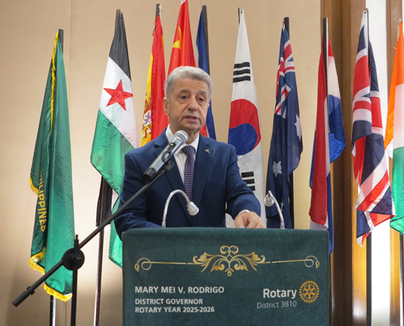
Past Director Issam Eldebs acknowledged the distinguished guests in attendance before the atmosphere shifted into one of warmth and celebration with musical performances by the RCM WF Music Chorale. Birthday celebrants included Past Director Amading Valdez, Rotarian Jerry Agnes, and Rotarian J. Alfonso L. Katigbak, all of whom were greeted with the traditional “Maligayang Bati” by the chorale.
Yet beneath the conviviality of fellowship and song lingered a sense that the afternoon’s true centerpiece was still to come.

Presentation of The Rotary Foundation's Recognition Gift
From left: VP Ricky Guevara, Multiple Paul Harris Fellow; VPE Karlo Castro, Major Donor; STAR Rtn. Coco Mauricio, New Paul Harris Fellow; and STAR Rtn. Oliver Pantaleon, New Paul Harris Fellow

During President’s Time, President Raoul C. Creencia led a special recognition for IT Arik Carranceja, acknowledging his invaluable support and contributions to the club. The recognition reflected the Rotary Club of Manila’s continuing appreciation for individuals whose quiet dedication often sustains the unseen machinery behind meaningful organizational work.
The introduction of the Guest of Honor and Speaker was delivered by Rotarian Shigeru Shimoda, who welcomed Atty. Mauricio not merely as a veteran diplomat, but as a public servant whose career had traversed some of the most important arenas of Philippine foreign service.

What followed was not the conventional diplomatic lecture many may have anticipated.
Instead, Atty. Mauricio offered something far more compelling: a sweeping historical meditation on the origins of diplomacy itself—one that transformed centuries of geopolitical evolution into a vivid and remarkably accessible human story.

The Origins of Diplomacy: From Kingdoms to Nations
Speaking with the cadence of a storyteller rather than the stiffness of a bureaucrat, Atty. Mauricio began not with treaties or international law, but with the timeless opening line of childhood fairy tales: “Once upon a time, in a kingdom far, far away, there lived a king.”

What initially sounded whimsical soon unfolded into an insightful framework for understanding the origins of diplomacy. Long before modern nation-states emerged, he explained, the world was divided into kingdoms ruled by kings, queens, princes, and princesses. These kingdoms were often in conflict, frequently over borders, territory, and power.
War, however, eventually exhausted even the mightiest rulers.

And so kingdoms sought peace.
To negotiate peace, one kingdom would send a trusted emissary—often a sibling, son, uncle, or other close relative — to another kingdom. The message carried by such an envoy was deeply symbolic: “Treat this person as if you were treating me, the king.”

In one of the afternoon’s most memorable lines, Atty. Mauricio described these early emissaries as “glamorized hostages.” If peace failed, the envoy’s life could be endangered. But if goodwill prevailed, these emissaries became living embodiments of trust between rival powers.
Thus, diplomacy was born not from abstractions, but from vulnerability, reciprocity, and mutual dependence.

As kingdoms evolved into empires and eventually into modern nation-states, the tradition remained. Relatives were replaced by professional diplomats, but the underlying principle endured: when one country sends an ambassador to another, it sends a representative who symbolically embodies the head of state itself.
Understanding the Ambassador Extraordinary and Plenipotentiary

Atty. Mauricio then guided the audience deeper into the architecture of modern diplomacy, particularly the meaning behind one of the most misunderstood diplomatic titles: Ambassador Extraordinary and Plenipotentiary.
The term “Extraordinary,” he explained, signifies that the ambassador is to be treated as though he were the very president or prime minister of the sending nation. In many countries, only two individuals are accorded the title “His Excellency”: the nation’s head of state and the ambassador representing another sovereign state.

The second word — “Plenipotentiary” — derives from the Latin roots plenum and potens, meaning “full power.”
Such ambassadors possess the authority to bind their governments in diplomatic engagements and agreements within their jurisdictions.

For many in attendance, the lecture became an education not merely in terminology, but in the immense trust and responsibility carried by those tasked with representing nations abroad.
Equally fascinating was Atty. Mauricio’s clarification that only ambassadors assigned to capital cities truly carry the rank and privileges associated with ambassadors extraordinary and plenipotentiary. Consuls General, despite their importance, are not ambassadors in the technical sense.

He cited Israel as a unique exception in diplomatic history, where embassies had historically been located in Tel Aviv instead of Jerusalem due to geopolitical pressures from neighboring states.
The audience listened intently—not merely because the lecture was informative, but because Atty. Mauricio possessed the rare gift of making international relations feel deeply human.
Diplomacy as the First Line of Defense
As his discourse progressed, the former Consul General shifted from history to contemporary relevance. Diplomacy, he stressed, becomes most crucial precisely during moments of conflict. Before nations deploy armies or engage in war, diplomatic channels must first be exhausted. Diplomacy remains humanity’s first line of defense against violence.

The statement carried unmistakable weight in an era increasingly defined by geopolitical tensions, territorial disputes, economic rivalries, and ideological fragmentation.
For the Rotarians gathered inside the Manila Polo Club that afternoon, the message resonated beyond statecraft. It was also a lesson in leadership, communication, restraint, and moral courage.

Atty. Mauricio further distinguished between political ambassadors and career ambassadors within the Philippine foreign service. Political ambassadors, he explained, serve largely at the pleasure of the President who appoints them, while career ambassadors may continue beyond a presidential term due to their professional standing within the foreign service corps.
But perhaps the most powerful part of his address emerged toward the conclusion, when he pivoted away from technical diplomacy and returned instead to Rotary itself.

Rotary as a Moral Compass
In a room filled with businessmen, professionals, civic leaders, and public servants, Atty. Mauricio reminded everyone that Rotary’s Four-Way Test is not merely ceremonial rhetoric. It is, in many ways, a moral framework for diplomacy, governance, and human relationships themselves.

“Is it the truth? Is it fair to all concerned? Will it build goodwill and better friendships? Will it be beneficial to all concerned?”
These questions, recited countless times in Rotary meetings across the world, suddenly acquired renewed depth under the lens of international relations.

Diplomacy, he implied, is ultimately not only about treaties and negotiations. It is about trust. About fairness. About the pursuit of peace without surrendering dignity.
And in that sense, Rotary and diplomacy share a common soul.

The Rotarian, much like the diplomat, serves as a bridge-builder.
The diplomat negotiates between nations. The Rotarian builds understanding among communities. Both seek peace, goodwill, and mutual progress.

By the time Atty. Mauricio concluded his address, the room was no longer merely listening to a lecture on foreign affairs. It had become immersed in a reflection on civilization itself — how societies evolved from kingdoms to nations, from warfare to dialogue, and from suspicion to cooperation.
An open forum followed, where members had the opportunity to engage directly with the distinguished speaker, further enriching the afternoon’s exchange of ideas. President Raoul C. Creencia later presented Atty. Mauricio with a Certificate of Appreciation in recognition of his insightful and thought-provoking address.

The meeting formally adjourned under the leadership of President Creencia.
Yet long after the gathering concluded, the resonance of the afternoon lingered.

For in a world increasingly fractured by division, misinformation, and conflict, Atty. Voltaire D. Mauricio reminded the Rotary Club of Manila that diplomacy — at its finest — is not merely a profession.
It is an act of civilization.

And perhaps, at its deepest level, Rotary itself is an expression of the same enduring hope: that human beings, despite differences in nation, ideology, religion, or background, can still choose dialogue over hostility, goodwill over suspicion, and understanding over conflict.
In the end, kingdoms may rise and fall, governments may change, and geopolitical alignments may shift.
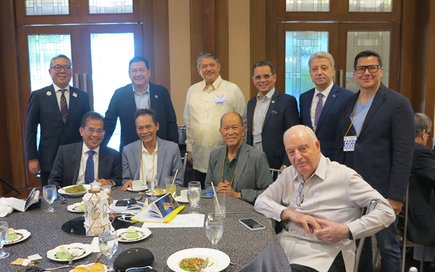
But truth, fairness, goodwill, and service remain timeless.
And that, perhaps, was the afternoon’s most enduring lesson. President Raoul Creencia presented former Philippine Consul General to Osaka and London, Atty. Voltaire D. Mauricio with a Certificate of Appreciation.


 Dr. GLENN BANAGUAS
 FORGED BY FIRE | The Life, Survival, and Reinventions of Dr. Günter Gerhard Klotz Matschuck
 Final Report: Rotary Global Grant GG2572214 (Cleft Lip/Palate Surgery for Marginalized Children/Youth)