

President’s Message

The Quiet Architecture of Impact: The Beauty of Club Flagship and Signature Projects
In every Rotary club, there are projects that respond to immediate needs, and there are those that ultimately come to define the club’s very identity. Beyond its distinguished standing as Asia’s First Club, the Rotary Club of Manila has likewise earned recognition, among many others, as a club whose awards carry genuine institutional weight, gravitas, and credibility — distinctions that are regarded not merely as ceremonial honors, but as meaningful affirmations of excellence, service, and public trust. Hence, RCM’s Outstanding Ambassador Awards, the TOWER Awards, and the Journalism Awards.
These are the signature projects — initiatives that transcend routine service activity and become enduring expressions of vision, purpose, and institutional character.
While the terms “signature” and “flagship” projects are often used interchangeably, there is a subtle distinction between them. A flagship project is usually the Club’s initiated project for a particular year, which is aimed to be carried on in the succeeding years. A signature project, on the other hand, reflects the unique personality and values of the club — the type of service initiative that people immediately associate with it. One emphasizes prominence; the other, identity. Yet both occupy a special place in the life of a Rotary club.
This Rotary year, three flagship projects were implemented by our esteemed Club – the LEAP (Leaders Excelling in ADR and Peacebuilding) Awards, ARAL (Advancing Resources for Accelerated Learning) Program, and Project RIVER (Rotary Initiative for Vulnerability Elimination and Resilience).
The journey toward implementing these projects has made this Rotary year memorable for me and all those involved in its conceptualization and planning. Flagship and signature initiatives often require long periods of consultation, fundraising, and execution. They demand not only financial resources, but also patience, persistence, and organizational discipline. Unlike one-time activities that may be completed within a single Rotary year, these projects frequently require continuity across multiple leadership cycles and the sustained commitment of many Rotarians.
And yet, precisely because of these demands, they become deeply fulfilling.
One source of fulfillment comes from the process of conceptualization itself. Every meaningful flagship project begins as an idea — sometimes modest, sometimes ambitious, but always rooted in a desire to create lasting value. Rotarians experience a distinct sense of purpose when they identify a community need and begin transforming abstract aspirations into a concrete service model.
The planning phase brings a different kind of fulfillment. Here, ideals are tested against practical realities. Budgets must be prepared. Partnerships must be formed.
Volunteers must be organized. Timelines must be established. Obstacles inevitably emerge.
This stage requires discipline and humility. We are fully aware that impactful service is not sustained by enthusiasm alone. It depends on structure, accountability, teamwork, and continuity. The challenge of transforming a vision into an executable program often strengthens club cohesion because members begin working not merely as volunteers, but as stewards of a shared mission.
Planning also teaches an important Rotary lesson: meaningful service is collaborative. No flagship or signature project succeeds because of a single leader. It succeeds because many individuals contribute different strengths — strategic thinkers, organizers, communicators, fundraisers, technical experts, and quiet workers who simply ensure that every detail is attended to. In this sense, the project becomes more than a community initiative; it becomes an exercise in collective leadership.
But perhaps the deepest fulfillment comes during implementation itself.
There is a profound emotional reward in witnessing a project move from paper into reality. These moments validate the countless hours spent in meetings, planning sessions, and fundraising activities. They remind Rotarians that service, when sustained with seriousness and compassion, can create tangible and enduring change.
Flagship and signature projects also provide another form of fulfillment that is often overlooked: institutional legacy.
Many Rotary activities are necessarily temporary, responding to immediate concerns or annual opportunities. But signature initiatives have the capacity to outlive individual presidents and officers. Over time, they become woven into the identity of the club itself.
This continuity creates a powerful sense of meaning because Rotarians realize they are participating in something larger than a single Rotary year. They become custodians of an institutional tradition of service.
There is also fulfillment in seeing younger or newer members eventually assume ownership of projects once initiated by earlier leaders. This transfer of stewardship reflects one of Rotary’s most important principles: continuity of service beyond individual leadership terms. A truly successful flagship project is one that no longer depends on its original proponents because the club itself has embraced and sustained the mission.
Importantly, not all fulfillment comes from scale or public recognition. Some of the most meaningful signature projects may remain relatively modest in size but deeply transformative in impact. The value of a Rotary project should never be measured solely by publicity, cost, or visibility. Often, the most enduring projects are those that consistently address genuine needs with sincerity and reliability.
Moreover, flagship and signature projects strengthen the moral identity of a club. They answer an essential question: What does this club stand for? Over time, these initiatives become visible manifestations of the club’s priorities, compassion, and values. They shape how communities perceive Rotary and how Rotarians perceive themselves.
Ultimately, the fulfillment derived from implementing flagship and signature projects lies not only in outcomes, but in the process itself. The experience demands vision, discipline, teamwork, resilience, and continuity. It transforms service from occasional activity into sustained institutional purpose.
And perhaps that is why these projects occupy such a special place in Rotary life. They are not merely programs. They are enduring expressions of commitment — reminders that when service is pursued with imagination, structure, and perseverance, it can leave a legacy far greater than any single year of leadership.

 Dr. GLENN BANAGUAS
 FORGED BY FIRE | The Life, Survival, and Reinventions of Dr. Günter Gerhard Klotz Matschuck
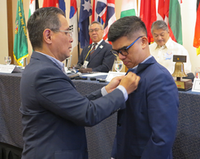 Diplomacy, Duty, and the Moral Compass of Nations: Rotary Club of Manila Welcomes Former Consul General Atty. Voltaire D. Mauricio at the 29th Weekly Membership Meeting